Think & Discuss
Quick Check
Inquiry Task
Reference answer: Wheat spread by manipulating Homo sapiens into laboring on its behalf. Growing wheat involves heavy labor such as removing stones, repeated weeding, controlling pests and diseases, driving off locusts and rabbits, drawing water from afar, and enriching the soil with manure, so humans invested ever more time and energy, and wheat spread around the world as a result. Key points: ① emphasize that the driving force behind its spread came from humans' sustained investment; ② list at least two specific tasks; ③ point out the shift in perspective from "humans domesticating plants" to "plants spreading by means of humans."
This is an open discussion question with no single correct answer. Evidence that could support "not a success": harder labor, possibly worse diet, bone and health evidence showing more disease, and the pressures brought by population growth. Evidence that could support "still a success": an increase in total food supply, a larger population, and the way settled life and social organization prepared the ground for later cities, technology and social differentiation. Scoring points: ① clearly state whether the criterion you adopt is species spread or human well-being; ② cite at least two pieces of evidence from the book; ③ point out regional differences and limitations in the evidence, and understand "the Agricultural Revolution is a fraud" as one of the author's interpretations rather than an established fact.
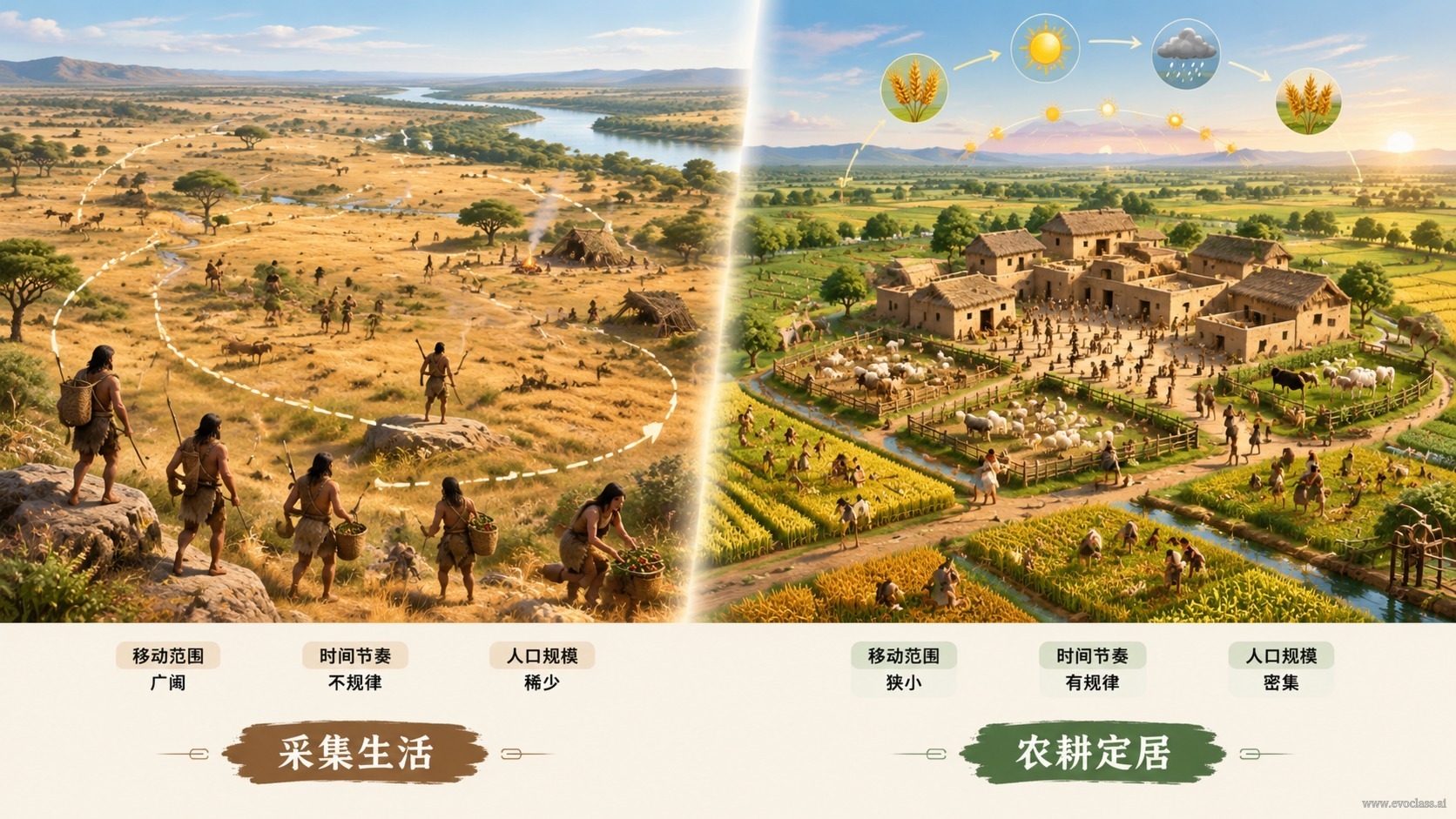
Learning objectives: to understand how, after the Agricultural Revolution, humans changed on thespatial,temporalandpsychologicallevels.
About ten thousand years ago, humans gradually shifted from hunting and gathering to farming and settled life. This was not a decision made on a single day but a slow process stretching over thousands of years: in many regions, foraging and farming coexisted for a long time, and the pace of the shift varied from place to place.
We should also pay attention to the narrative itself. Telling the Agricultural Revolution as a story of progress in which "humans grew ever smarter, gave up hardship and settled into comfortable abundance" is only one account.Harari offers the opposite judgment in Sapiens: farmers' work was generally harder than that of foragers, and their diet ended up even worse, so he calls the Agricultural Revolution "history's biggest fraud." This is one interpretation and stance of the author, not a fact settled by scholarship—archaeological evidence from different regions in the same period is inconsistent, with some showing a decline in health and others showing relatively stable living conditions.
| Dimension | Foraging life | Farming and settled life |
|---|---|---|
| spatial | Moved with seasonal resources; had a wide range of activity, and camps shifted as resources changed | Tied to a limited area of land; fields, villages and land boundaries shrank the range of movement while driving population density upward |
| temporal | The rhythm followed when resources appeared, and people harvested what was available at the time | People had to follow the cycle of sowing, irrigation, harvest and storage, and began to organize life around seasons and years |
| psychological | Mainly responded to the immediate situation and the harvest of the season | Had to plan for the future: saving seeds, storing surplus grain and anticipating climate and crop-failure risks, giving rise to delayed gratification and anxiety about uncertainty |
Farmers could hardly "find it today, eat it today" as foragers did. Seeds had to be kept for the next sowing season, and grain had to last through the lean period before the next crop. Thusplanning for the futurewas no longer a personal preference but a condition of survival: storing, scheduling labor, anticipating climate and bearing the consequences of a poor harvest.
Settled life and surplus grain also opened another door: storable wealth made social differentiation possible, providing the material conditions for rule, an elite class and "orders built on imagination." This page only touches on the point without elaborating—why large-scale human cooperation requires a shared imagined order is left for later discussion.
Timeline or Comparison ChartLook at the timeline or comparison chart in the image and consider how it relates to "the Agricultural Revolution began about ten thousand years ago, when humans shifted from hunting and gathering to farming and settled life."